v1.0

v1.0

/

/

Why we open-sourced ApowerB: building a production AI agent runtime in the open

Why we open-sourced ApowerB: building a production AI agent runtime in the open

Why we open-sourced ApowerB: building a production AI agent runtime in the open

We open-sourced ApowerB because the runtime between models, enterprise data and real-world tools should be inspectable. This is why we chose an open runtime, what production problems shaped it and how it fits alongside thaink².

Aucun heading trouvé dans #cible

Adil Harcha

We open-sourced ApowerB because the runtime around an AI agent is too important to be a black box.

When an agent can call tools, store memory, query company data, run on a schedule and survive process restarts, the critical engineering questions move beyond the model. Teams need to understand where state lives, how tools are invoked, what happens after failure and which parts of the stack remain under their control.

ApowerB is our answer to that layer: an open-source agent runtime and platform for building and operating agents beyond the demo.

Why open source the runtime?

The model is often supplied by another provider. The business tools belong to the enterprise. The data belongs to the enterprise. We believe the runtime connecting those pieces should be inspectable.

Open source creates several useful properties:

  • Inspectability: developers can review how execution, state and integrations are implemented.

  • Self-hosting: teams can run the runtime in infrastructure they control.

  • Extensibility: integrations and runtime behavior can evolve without waiting for a closed product roadmap.

  • Portability: the application does not have to be inseparable from one model provider or one hosted control plane.

  • Community feedback: production edge cases can be discussed in public rather than hidden behind product claims.

These ideas are visible across the current ecosystem. Microsoft has continued to open-source core agent infrastructure; newer runtimes such as OpenLoop, Run Core and A3T emphasize inspectability, self-hosting, memory and orchestration as part of the production agent layer.

The gap we were trying to solve

Agent frameworks make it increasingly easy to define tools, prompts and agent logic. The difficult part appears after the first successful demo.

Production raises questions such as:

  • Where does session state live after the worker restarts?

  • How are tool calls recorded?

  • Can a failed run be safely replayed?

  • How are credentials and permissions scoped?

  • How does the system deploy to Kubernetes?

  • How do operators understand cost and failures?

We documented several of those lessons publicly on DEV.to, including why an agent framework can stop at the demo, what a real Kubernetes deployment involves and how process restarts exposed problems in agent memory and replay.

Those field notes became a useful way to test our own claims against the code.

ApowerB is not “open source” as a marketing page

The useful part of open source is not the badge. It is that someone can inspect the system and disagree with us.

A developer should be able to ask:

  • How are sessions persisted?

  • What happens when a tool has already executed and a run fails?

  • Which components are required to deploy?

  • Where are model/provider choices configured?

  • Which parts can be replaced?

If those questions cannot be answered by looking at the code and documentation, “open source” has limited operational value.
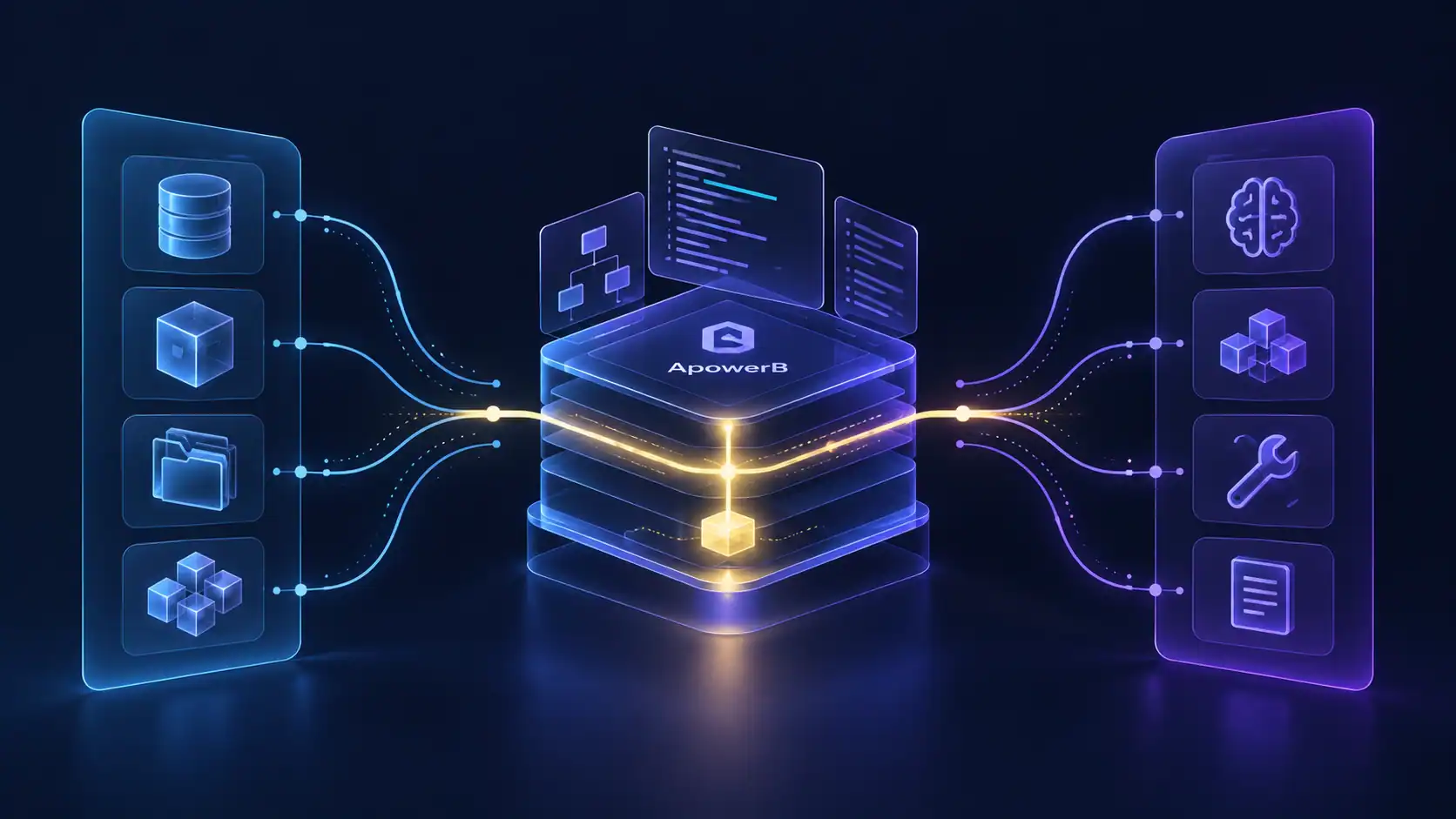

Open-source ApowerB runtime connecting enterprise infrastructure with models and tools while keeping the agent control layer inspectable.

Why a runtime matters more as agents become more capable

A simple chatbot can often be treated like a request-response application. An agent that acts through tools cannot.

The runtime becomes responsible for the space between intention and consequence:

  • execution lifecycle;

  • state and memory;

  • tool invocation;

  • orchestration;

  • retries and failure handling;

  • observability;

  • deployment.

Our reference guide on production-ready AI agents explains this architecture in more detail.

One production lesson: persistence is not enough

During one deployment audit, we saw roughly eight application restarts per day. Moving sessions from process memory into durable storage solved the obvious amnesia problem, but it exposed a harder question: if a run already called a tool before failing, is it safe to execute it again?

That led us to distinguish conversation memory from run state and real-world side effects. The full engineering write-up is available in our DEV.to incident report and in the expanded guide to AI agent state management.

Why self-hosting matters to some teams

Not every organization needs to self-host its agent runtime. Managed infrastructure can be the better operational choice.

Self-hosting becomes important when teams need:

  • control over deployment topology;

  • private networking requirements;

  • specific data residency or integration constraints;

  • the ability to inspect or modify runtime behavior;

  • less dependency on one hosted platform.

Our Kubernetes deployment guide documents what self-hosting actually requires beyond a one-command install.

Open source and thaink² are complementary

ApowerB and thaink² solve different parts of the same problem.

ApowerB gives developers an open runtime they can inspect and operate. thaink² packages agentic data, analytics and knowledge experiences for enterprise teams and adds the surrounding product and service layer.

The open-source runtime also forces us to separate what is genuinely reusable infrastructure from what belongs to a specific product experience.


Inspect the runtime yourself

Explore ApowerB, read the architecture and follow the production issues in the open.


What we want from the open-source project

The goal is not to maximize the number of abstractions. It is to make the production path easier to inspect and improve.

That means prioritizing problems such as durable state, clear tool execution, provider flexibility, deployment, observability and safe operations—the parts that usually appear after an agent already works in a notebook.

It also means documenting limitations. Production agent infrastructure is still young, and pretending every failure mode has been solved would make the open-source model less useful, not more.

Frequently asked questions

What is ApowerB?

ApowerB is an open-source runtime and platform for building and operating AI agents, with an emphasis on the production layer around execution, state, tools and deployment.

Why did thaink² open-source ApowerB?

Because the runtime connecting enterprise data, tools and models benefits from being inspectable, self-hostable and extensible.

Is ApowerB the same product as thaink²?

No. ApowerB is the open-source runtime layer; thaink² is the broader enterprise platform and services offering built around agentic data and AI workflows.

Can ApowerB be self-hosted?

ApowerB is designed for deployment on infrastructure controlled by the team using it; requirements depend on the selected architecture and current project release.

Where can developers learn more?

Developers can explore the open-source page, GitHub project and the engineering field notes published on DEV.to.

An open-source foundation for building your own agents.

ApowerB is the open-source agentic framework developed by thaink² to build, orchestrate, and operate AI agents on your own stack, using your models, tools, and data.

What if your next analysis were ready before your next meeting?

Show us your environment and a use case. See how thaink² can query, monitor, and act on your data.

Our mission
Our vision

Move from data you look at to data that works continuously for your business.

We believe the next generation of Data platforms will do more than show what happened. They will monitor, explain, anticipate, and prepare decisions before some questions even need to be asked.

Image

What is an Agentic Data Platform?

An Agentic Data Platform uses specialized AI agents to work with enterprise data. Unlike a static dashboard or a simple chatbot, agents can explore multiple sources, run analyses, generate visualizations, produce deliverables, and execute recurring missions.

What’s the difference between Proactive Mode and Exploratory Mode?

In Exploratory Mode, the user asks a question and thaink² runs the analysis on demand. In Proactive Mode, a mission is defined in advance: agents monitor the data based on a set schedule or specific conditions and automatically deliver the relevant results.

Do I need to know SQL to use thaink²?

Not for business use cases. Users can ask questions in natural language and get analyses, tables, charts, and dashboards without writing SQL queries themselves.

What data sources can thaink² connect to?

The platform is designed to work with the systems already in place across your organization: databases, data warehouses, ERP, CRM, APIs, files, and document repositories. Available connectors depend on your environment and use case.

What types of outputs can the agents produce?

Depending on the agent and use case, outputs can include analyses, tables, charts, dashboards, forecasts, alerts, summaries, and reports. The goal is to deliver an actionable result, not just a text response.

Can thaink² be deployed on our own infrastructure?

thaink² supports deployment options designed around enterprise requirements, including organizations that need greater control over their infrastructure, models, and data. Our teams help define the architecture that best fits the project.

Which part of the thaink² ecosystem is open source?

ApowerB is the open-source agentic framework developed by thaink². It enables technical teams to build and operate their own agents, with support for RAG, Text-to-SQL, multi-LLM setups, and APIs.

How do I get started with thaink²?

The easiest way to start is with a concrete use case: reporting, analysis, forecasting, document search, or monitoring. An initial session helps define the available data, expected outcomes, and the most suitable deployment approach.

Join our Discord community

Connect with builders, Data teams, and AI practitioners. Share ideas, get technical help, discuss agentic architectures, and follow the latest developments around ApowerB.

Our newsletter (Soon)

Data that takes action, straight to your inbox.

Field insights, agentic architectures, benchmarks, use cases, and the latest from ApowerB. Only what’s worth reading.

© 2026 thaink² SAS — All rights reserved

An open-source foundation for building your own agents.

ApowerB is the open-source agentic framework developed by thaink² to build, orchestrate, and operate AI agents on your own stack, using your models, tools, and data.

What if your next analysis were ready before your next meeting?

Show us your environment and a use case. See how thaink² can query, monitor, and act on your data.

Our mission
Our vision

Put the power of data in the hands of decision-makers.

Today, too many business questions still depend on an export, a dashboard, or the availability of a Data team. thaink² changes that by letting teams query their data directly, while agents handle the analysis and recurring work.

Image

What is an Agentic Data Platform?

An Agentic Data Platform uses specialized AI agents to work with enterprise data. Unlike a static dashboard or a simple chatbot, agents can explore multiple sources, run analyses, generate visualizations, produce deliverables, and execute recurring missions.

What’s the difference between Proactive Mode and Exploratory Mode?

In Exploratory Mode, the user asks a question and thaink² runs the analysis on demand. In Proactive Mode, a mission is defined in advance: agents monitor the data based on a set schedule or specific conditions and automatically deliver the relevant results.

Do I need to know SQL to use thaink²?

Not for business use cases. Users can ask questions in natural language and get analyses, tables, charts, and dashboards without writing SQL queries themselves.

What data sources can thaink² connect to?

The platform is designed to work with the systems already in place across your organization: databases, data warehouses, ERP, CRM, APIs, files, and document repositories. Available connectors depend on your environment and use case.

What types of outputs can the agents produce?

Depending on the agent and use case, outputs can include analyses, tables, charts, dashboards, forecasts, alerts, summaries, and reports. The goal is to deliver an actionable result, not just a text response.

Can thaink² be deployed on our own infrastructure?

thaink² supports deployment options designed around enterprise requirements, including organizations that need greater control over their infrastructure, models, and data. Our teams help define the architecture that best fits the project.

Which part of the thaink² ecosystem is open source?

ApowerB is the open-source agentic framework developed by thaink². It enables technical teams to build and operate their own agents, with support for RAG, Text-to-SQL, multi-LLM setups, and APIs.

How do I get started with thaink²?

The easiest way to start is with a concrete use case: reporting, analysis, forecasting, document search, or monitoring. An initial session helps define the available data, expected outcomes, and the most suitable deployment approach.

Join our Discord community

Connect with builders, Data teams, and AI practitioners. Share ideas, get technical help, discuss agentic architectures, and follow the latest developments around aPowerB.

Our newsletter (Soon)

Data that takes action, straight to your inbox.

Field insights, agentic architectures, benchmarks, use cases, and the latest from ApowerB. Only what’s worth reading.

© 2026 thaink² SAS — All rights reserved