
Agentic AI governance is not only about model safety. It is about controlling delegated authority across data, tools and business systems, then keeping enough evidence to prove what each agent was allowed to do and what it actually did.

Aucun heading trouvé dans #cible
An agentic AI governance framework is the operating system for delegated authority. It defines which agents may exist, who owns them, what data and tools they can access, which actions they may take, when a human must intervene, what evidence must be retained and how authority changes or ends over time.
That is a different problem from governing a model that only generates content. An enterprise agent can call APIs, query databases, update records, send messages, trigger workflows and coordinate with other agents. The main governance question is therefore not only “is the model accurate?” It is also “what authority has this system been given, and can the organization prove that the authority remains bounded?”
This guide proposes a practical thaink² model for answering that question. It is not a regulatory standard and it does not replace legal or compliance review. It is an operational framework for connecting ownership, permissions, runtime controls, evaluation, observability and lifecycle management around enterprise agents.
What is an agentic AI governance framework?
An agentic AI governance framework is a structured set of organizational decisions and technical controls that governs autonomous or semi autonomous AI agents throughout their lifecycle.
A useful framework should be able to answer six questions about every production agent:
What is the agent allowed to achieve?
Who is accountable for its outcomes?
Which data, systems and tools can it reach?
Which actions can it execute without approval?
How can its behavior be observed and evaluated?
How can its authority be changed, suspended or retired?
If a team cannot answer those questions quickly, the problem is not merely documentation. It means the organization may not know the real operating boundary of the agent.
Why agent governance is different from traditional AI governance
Traditional AI governance is often organized around models, data, outputs, fairness, privacy, validation and regulatory risk. Those concerns still matter. Agents add another layer because they can act through tools and systems.
A model can produce a bad recommendation. An agent with sufficient authority can turn a bad recommendation into a database change, an external message, a financial action or a sequence of downstream tool calls before a person reviews it.
OWASP describes excessive agency as a risk created by excessive functionality, excessive permissions or excessive autonomy. Its 2026 work on agentic security also emphasizes inspectability, traceability and runtime control. Those ideas point to the same governance principle: capability must be separated from permission. An agent may technically be capable of an action without being authorized to perform it in every context.
This distinction is the foundation of enterprise agent governance.
The thaink² authority envelope
For this guide, we use an original thaink² model called the authority envelope. It describes the boundary inside which an agent is allowed to operate.
The model has six control layers. None is sufficient on its own.
Control layer | Question it answers | Minimum evidence |
|---|---|---|
Mission | What outcome is this agent responsible for? | Approved purpose, scope and prohibited use cases |
Ownership | Who answers for the agent? | Named business owner and technical owner |
Reach | What can the agent see or call? | Data classes, systems, tools and identities |
Action | What can the agent change? | Allowed operations, limits and denied actions |
Oversight | When does a human have to intervene? | Approval rules, escalation thresholds and shutdown authority |
Evidence | Can the organization reconstruct what happened? | Logs, evaluations, traces, versions and review records |
The authority envelope is useful because it forces governance to describe the real execution boundary, not just the policy intent. A statement such as “the agent may support procurement” is too broad. A governed version would specify which vendor records it may read, which purchase orders it may create, the value threshold that requires human approval and the evidence retained for every action.

Governance intensity should follow authority, impact and reversibility
Not every agent needs the same controls. A read only research assistant and an agent that can modify financial records should not pass through an identical governance process.
A useful mental model is simple: governance intensity should increase as autonomy, system reach and business impact increase, and as reversibility decreases.
Operating level | Typical behavior | Default governance posture |
|---|---|---|
Observe | Reads approved information and produces a summary | Registered owner, governed data access, logging and output evaluation |
Recommend | Analyzes information and proposes an action | All observe controls plus clear human decision ownership |
Act within limits | Executes low impact or reversible actions inside defined boundaries | Explicit tool permissions, runtime limits, monitoring, rollback and escalation |
Act with material impact | Can affect money, customers, production systems, legal obligations or sensitive data | Formal risk review, human approval thresholds, stronger evidence, incident ownership and tested shutdown procedures |
The point is not to create a universal four level standard. The point is to prevent a common failure mode where an organization applies the same lightweight approval process to agents with radically different authority.

Why AI agent governance becomes an organizational design problem
Once several teams can deploy agents, governance stops being a document owned by one department. It becomes a question of decision rights.
The business owner should define the outcome and accept responsibility for the workflow. The technical owner should understand how the agent is built, connected and changed. Security should define control requirements for identity, permissions and incident response. Data owners should determine which information the agent may use. Platform or operations teams should make behavior observable in production.
The exact structure will vary, but one principle should not: an agent should never reach production without named operational ownership.
This is also why AI agent management, governance and observability should not be treated as synonyms. Governance defines the rules and accountability. Management applies lifecycle processes around the agent fleet. Observability provides evidence about what agents actually do. A mature operating model connects all three.
For a deeper explanation of the evidence layer, see what AI observability means in production and the AI agent observability solution page.
Start with an agent registry, but do not stop there
An inventory is necessary because an organization cannot govern an agent it does not know exists. But a list of names and owners is not enough.
A useful agent governance record should capture the information required to make an authorization decision and later review it.
Field | What should be recorded |
|---|---|
Identity | Agent name, unique identifier, environment and version |
Mission | Business objective and explicit out of scope behavior |
Owners | Business owner, technical owner and escalation contact |
Data | Data classes, sources, retention expectations and sensitive information |
Tools | APIs, databases, applications, MCP servers and other callable capabilities |
Permissions | Read, write, create, delete, send, approve and any financial or production authority |
Autonomy | What can happen without human approval and under which limits |
Evaluation | Required tests, thresholds and known failure conditions |
Observability | Logs, traces, usage, cost, alerts and review ownership |
Recovery | Shutdown path, rollback capability, fallback process and incident owner |
Lifecycle | Approval date, review cadence, change history and retirement criteria |
This record is more useful than an inventory because it connects the agent to its actual authority. It also gives reviewers a stable artifact when models, tools or permissions change.
Identity and permissions should follow the principle of least privilege
Agents should be treated as active system identities rather than abstract AI features.
If an agent only needs to read a customer record, it should not inherit permission to update or delete it. If it can access one approved dataset, a generic credential should not silently expose unrelated tables. If it acts on behalf of a user, the system should preserve the relevant authorization context rather than collapsing every request into one high privilege service account.
This becomes more important in multi agent systems. One agent should not automatically inherit another agent’s authority simply because the two can communicate. Trust between agents needs its own identity and authorization model.
OWASP’s guidance on excessive agency reinforces the same principle by recommending minimum necessary functionality, permissions and autonomy.
How do you make AI agents comply with internal data governance policies?
Make data policy enforceable at the point where the agent reads, writes or sends data, not only in a document. Classify the data each agent may touch, grant access through the agent’s own identity, apply the same masking and retention rules that apply to people and applications, and log every access so compliance can be shown later.
Telling an agent in its prompt to “avoid sensitive data” is guidance, not a control. A prompt can be misread, overridden by injected content or lost when the workflow changes. Data governance only holds when the surrounding system refuses access the agent has not been granted.
Map data classes to agents. Record in the agent governance record which classes of data, such as public, internal, confidential or regulated, each agent may read, write or pass to another system.
Enforce at the data layer. Use scoped credentials, row and column restrictions and approved data sources so the agent cannot retrieve what the policy excludes.
Control outbound movement. Define which tools may send data outside the organization and which fields must be removed or masked first.
Respect purpose and retention. Limit what an agent keeps in memory, logs and intermediate state to what the mission needs, and apply the retention rules your data owners already define. Our guide to AI agent state management covers where that state lives.
Evidence every access. Retain which agent version accessed which data, for which request, so that data owners can review it.
Data owners should approve the data scope in the same review that approves the tools. If a legal or privacy team has a position on a specific data type or jurisdiction, that position should be translated into a technical restriction rather than left as an instruction to the agent.
Tool access is where governance becomes operational
Policies become meaningful when they can affect execution.
A production governance layer should know which tools the agent may call, which operations are allowed, what parameters are acceptable and when a request must be blocked or escalated. The control should sit outside the agent’s reasoning whenever possible so that the same model cannot both decide an action and redefine the policy that authorizes it.
This matters for API based tools, internal functions and newer connection protocols such as MCP. The OWASP Agent Control Standard, published in September 2026, focuses specifically on inspectable agents and runtime policy enforcement through standardized control hooks.
For workflows that coordinate tools and multiple steps, AI agent orchestration should be evaluated together with governance. Orchestration decides how work moves. Governance decides which paths are permitted.
How do you govern AI agents and APIs under one policy framework?
Treat agents and human-built APIs as callers of the same governed resources. Apply one set of identity, authorization, rate, data and logging policies at the shared enforcement point, then add agent-specific rules for the things APIs do not have: non-deterministic decisions, chained tool calls and delegated authority.
A conventional API has a known caller, a fixed request pattern and behavior that was reviewed when it was written. An agent chooses which calls to make at run time. That difference does not require a second governance stack, but it does require the existing one to be extended.
Policy area | Applies equally to agents and APIs | Extra for agents |
|---|---|---|
Identity | Every caller has a unique, revocable identity | Per-agent and per-version identity, plus the user context the agent acts for |
Authorization | Least privilege on each operation and resource | Explicit tool allow and deny lists, and limits on delegation between agents |
Limits | Rate, quota and value limits | Loop, step and cost budgets per task |
Data | Classification, masking and retention rules | Controls on what enters prompts, memory and outputs |
Evidence | Request and response logging | Trace of the reasoning steps, tool calls and approvals behind each action |
Change | Versioned releases and review | Review when the model, prompt, tools or permissions change |
The practical benefit is consistency. A security team that already reviews API access can reuse its review process, and an agent cannot reach a system through a path that the API policy would have blocked. For the tooling side of this decision, see our comparisons of AI agent frameworks and AI orchestration platforms.
Human oversight should be triggered by risk, not added everywhere
Requiring a person to approve every action can make an agent useless. Requiring approval for nothing can make it unsafe.
The useful question is which decisions cross a threshold where human judgment is required. That threshold can depend on financial value, customer impact, data sensitivity, legal consequence, irreversibility or confidence.
A low risk agent might automatically tag an internal record. A procurement agent may create orders only below an approved amount. A finance agent may analyze a variance autonomously but require a human before changing an accounting record.
Human in the loop is therefore not a universal mode. It is a control that should appear at specific decision boundaries.
Observability and evaluation turn governance into evidence
A governance policy says what should happen. Operational evidence shows what actually happened.
That evidence should connect the agent’s identity, version, inputs, tool calls, actions, outputs and evaluations. Teams need enough context to investigate a failure and enough continuity to understand whether behavior changes after a model, prompt, tool or data update.
Evaluation should also be tied to the agent’s mission. A generic language score does not tell a finance team whether an agent calculated the correct variance or a support team whether an action complied with escalation policy.
In thaink², AgentOps focuses on monitoring agent activity, evaluating outputs and understanding usage and cost. Those signals can support governance because they create an operational evidence layer. They do not replace organizational ownership, access control or policy enforcement in connected systems.
Cost and usage also belong in governance
Governance is often framed only as safety and compliance, but resource authority matters too.
An agent that can launch long analytical loops, call expensive models repeatedly or trigger large downstream workloads can create operational waste even when every individual action is technically allowed.
Teams should therefore define reasonable usage boundaries, attribution and review criteria. Cost visibility becomes more useful when it is connected to quality and business outcome rather than treated as a standalone infrastructure metric.
Governance has to follow the full agent lifecycle
An agent that was safe when approved can become risky later because its data, tools, model, workflow or organizational context changed.
Governance should therefore apply across design, validation, deployment, runtime, review and retirement.
Design: define mission, owner, authority and prohibited actions.
Validation: test permissions, failure scenarios, evaluations and escalation paths.
Deployment: activate the approved identity, tools, monitoring and ownership.
Runtime: enforce policy, log behavior, evaluate outcomes and detect anomalies.
Review: recertify access and reassess risk after meaningful changes.
Retirement: revoke credentials, disable tools and preserve the evidence required for audit or investigation.
The final step is easy to ignore. An unused agent with active credentials is still an authorization problem.

Multi agent systems create governance dependencies
A single agent can be evaluated as one unit of authority. A multi agent workflow creates chains of authority.
An orchestrator may route work to a research agent, a data agent and an execution agent. Each component can have appropriate permissions in isolation while the combined workflow creates a broader capability than any single owner intended.
Governance therefore needs to examine not only individual agents but also how authority propagates through the chain. Which agent can delegate work? Which context is shared? Which credentials travel with the request? Which component can commit the final action?
This is especially important when teams adopt reusable tools or external protocols because the effective authority of an agent can change without its prompt changing at all.
Agentic AI governance for retail and agentic commerce
Before an agent transacts, an enterprise retailer should be able to show five things: who or what the agent is, how much it may spend or commit, which actions need approval, who is liable when it is wrong, and where the audit trail lives. Governance for agentic commerce is delegated authority applied to money, customers and orders.
The same pattern applies to adjacent domains such as treasury or procurement, where an agent can move value rather than only recommend it. The framework above does not change. The limits become tighter and the evidence requirements become stricter because the actions are harder to reverse.
Identity: a verifiable identity for each agent, tied to the customer, buyer or business unit it acts for, so that counterparties and internal systems can tell who authorized the action.
Spend and commitment limits: per-transaction, per-period and per-counterparty ceilings, set by the accountable owner and enforced outside the agent’s reasoning.
Approvals: thresholds by value, customer impact, new counterparty or irreversibility that route the action to a person before it executes.
Liability: an agreed allocation of responsibility between the business owner, the technology owner and any third-party platform or merchant, reviewed by legal before launch rather than after an incident.
Audit: a record of the instruction, the options the agent considered, the tool calls made, the approvals obtained and the final transaction, retained for the period your finance and compliance teams require.
Start with agents that recommend or prepare transactions, then allow execution inside narrow limits once the evidence shows the controls hold. Widen authority only through the same review that granted it. Refund, pricing and order-change agents deserve the same treatment as any other agent that can change money or customer records.
Incident response needs to be designed before the incident
A mature framework should define who can stop an agent, how execution is isolated, what can be rolled back and which evidence is preserved.
The shutdown path should be tested. If a high impact workflow cannot be suspended quickly without disabling unrelated systems, the control design is incomplete.
Recovery also depends on reversibility. Sending an incorrect internal tag is different from sending an external payment or deleting a production record. Governance should account for that difference before the action is delegated.
How should agent governance map to NIST, ISO, the EU AI Act and OWASP?
An internal agent governance framework should not pretend to replace recognized standards or regulation. It should make it easier to connect operational controls to them.
Reference | How it helps | What it does not do |
|---|---|---|
NIST AI RMF | Provides a voluntary risk management structure around govern, map, measure and manage. | It is not an agent specific runtime control standard, and NIST notes that AI RMF 1.0 is being revised. |
ISO/IEC 42001 | Provides requirements for establishing and continually improving an AI management system. | It does not prescribe one technical architecture for AI agents. |
EU AI Act | Creates legal obligations based on the role and risk of AI systems in the European Union. | It does not create one universal agent governance checklist for every deployment. |
OWASP agentic guidance | Provides practical security guidance around excessive agency, agentic risks and runtime control. | Security guidance alone does not define business ownership or every compliance obligation. |
Useful primary references include the NIST AI Risk Management Framework, ISO/IEC 42001, the official EU AI Act text, the OWASP Agent Control Standard and the OWASP State of Agentic AI Security and Governance.
The mapping should be reviewed by the appropriate legal, security and compliance teams for the organization’s actual jurisdiction and use case.
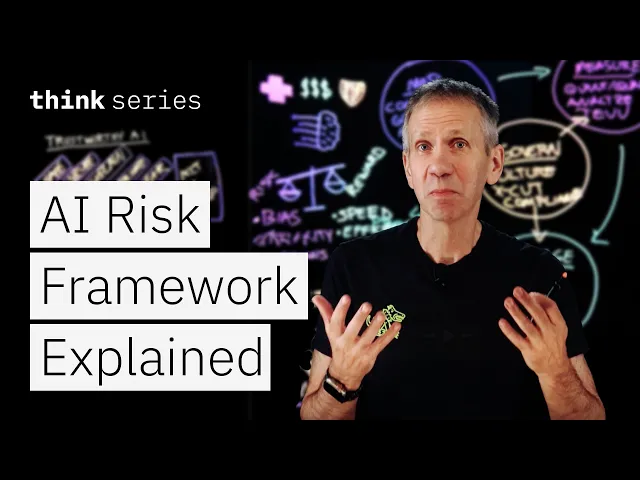
Source : IBM Technology, verified YouTube channel
What does a minimum viable governance process look like?
A team does not need a giant governance bureaucracy before it can improve control. It does need consistent decisions.
A practical starting process is:
Register every agent that can touch enterprise data or tools.
Assign business and technical owners.
Describe the authority envelope in concrete terms.
Classify the workflow by autonomy, impact and reversibility.
Grant only the data and tool permissions required for the mission.
Define human approval thresholds and prohibited actions.
Test expected behavior, failure cases and recovery before production.
Enable logging, evaluation, usage visibility and incident escalation.
Review the agent when its model, tools, permissions or mission changes.
Retire authority deliberately when the agent is no longer needed.
This sequence is intentionally operational. A policy that cannot be translated into a deployment decision, runtime control or reviewable record will be difficult to enforce at scale.
What good governance looks like in practice
Well-governed agent programs share a few recognizable patterns. They are described here as generic patterns, not as named customer examples, and they should be adapted to your own risk profile.
Start narrow. The first production agents have a single mission, a named owner and read-only or low-impact authority.
One record per agent. Owners, tools, data scope, approval thresholds and review dates live in the registry, not in individual heads.
Controls outside the model. Permissions, limits and approvals are enforced by the surrounding system.
Authority grows through evidence. An agent earns wider permissions after logged behavior and evaluations support it.
Review is triggered by change. A new model, tool or permission reopens the approval.
Shutdown is rehearsed. Teams have practiced stopping and rolling back an agent before they need to.
Multi-agent chains are mapped. Someone has traced how authority propagates through delegation, as explained in our overview of multi-agent systems.
What makes a system agentic from a governance perspective is exactly this: it chooses actions and uses tools on its own, so its authority has to be governed in addition to its outputs.
Questions to ask before approving an enterprise AI agent
Before a production approval, reviewers should be able to answer the following without relying on undocumented team knowledge:
What exact business outcome is the agent responsible for?
Who owns the outcome if the agent is wrong?
Which systems can it read from and write to?
Which tools can it invoke and which functions are explicitly denied?
What is the highest impact action it can take without approval?
Which actions are difficult or impossible to reverse?
How are tool calls, outputs and decisions reconstructed after the fact?
Which evaluations must pass before a new version is promoted?
Who can stop the agent during an incident?
What event forces a permissions review or retirement decision?
If the organization cannot answer these questions, increasing model intelligence should not be the next governance priority.
What governance evidence should you demand before buying agentic AI?
Ask the vendor to show, not describe, how control works in operation. The most useful evidence covers identity and permissions, enforcement outside the model, human approval, audit logs, evaluation results, data handling, change management and incident response, supplied in a form your security and compliance teams can inspect.
Marketing claims about “responsible AI” are not governance evidence. Use the checklist below in procurement and security review, and ask for each item in writing or in a live demonstration against your own scenario.
Agent identity model: how each agent and agent version is identified, and how credentials are issued and revoked.
Permission model: how read, write and action rights are scoped per agent, tool and data source.
Policy enforcement: whether limits are enforced outside the model, and what happens when the agent attempts a blocked action.
Human approval controls: how thresholds are configured, who can approve, and how approvals are recorded.
Audit trail: a sample trace linking instruction, tool calls, outputs and approvals, with details of retention and export.
Evaluation evidence: how behavior is tested against your mission, how results are kept, and how regressions are caught after changes.
Data handling: where data is processed and stored, what is retained, and how it is separated between customers.
Change management: how model, prompt and tool updates are versioned, communicated and rolled back.
Incident response: who can stop an agent, how quickly, and what evidence is preserved.
Independent assurance: relevant third-party reports or certifications, and exactly which product or scope they cover.
Red flags to treat as unresolved risk:
Controls that exist only as prompt instructions.
No way to see or export what the agent actually did.
Shared credentials across agents, customers or environments.
Certifications that cover the vendor’s company but not the product you would use.
Refusal to run a demonstration against a realistic scenario of yours.
No defined process for stopping or rolling back an agent.
What to look for in an AI agent governance platform, and how to think about ROI
A governance platform should make the authority envelope enforceable and visible. Look for a registry of agents, scoped identity and permissions, runtime policy enforcement, human approval workflows, observability and evaluation, and lifecycle controls. Judge return on investment by risk avoided, review effort saved and the work you can safely delegate.
Agent registry with owners, missions, tools, data scope and version history.
Identity and access that integrates with the systems where permissions already live.
Runtime policy enforcement over tool calls, parameters and spend.
Approval workflows with thresholds, routing and recorded decisions.
Observability and evaluation tied to each agent’s mission. See our comparison of AI observability tools.
Lifecycle management for review, suspension and retirement.
Reporting that maps controls to the frameworks your auditors use.
Open integration so governance does not depend on a single model or framework.
Governance products overlap with orchestration, observability and security tooling, so decide which layer you already own. Our guide to production-ready AI agents shows how these layers fit together, and the thaink² platform page describes how thaink² approaches the operational side.
Thinking about ROI. Governance rarely creates value by itself. It creates the conditions under which agents can be trusted with more work. The main levers are qualitative until you measure them in your own environment:
Faster approvals because reviewers use one consistent record and process.
Less rework and fewer incidents because limits are enforced before an action, not discovered afterwards.
Lower audit effort because evidence is collected as the agent runs.
Wider safe delegation because higher-impact workflows become permissible once controls are proven.
Cost control because usage is attributed and bounded.
Set a baseline before rollout, such as time to approve an agent, incidents, audit preparation effort and exceptions, and compare it afterwards. Do not rely on a vendor’s generic percentage.
How thaink² fits into the governance operating model
thaink² is built around specialized agents and explicit missions. That makes the mission itself a useful governance unit: teams can reason about what an agent is expected to do instead of treating every interaction as an isolated prompt.
The operational layer matters just as much. thaink² AgentOps is designed around monitoring, evaluation and usage visibility so teams can inspect how agents behave and how outputs perform over time.
That evidence can support an enterprise governance program, but it should not be confused with the entire program. Identity, permissions, legal accountability, data governance and controls in connected systems remain part of the broader enterprise architecture.
For teams designing that operating model, explore AI agents for data and IT teams, AI agent workflows for AI and ML engineering teams and the thaink² platform.
The practical takeaway
The most useful way to govern enterprise AI agents is to govern their authority, not only their intelligence.
A strong framework gives every agent an accountable owner, a bounded mission, a controlled identity, explicit data and tool permissions, defined approval thresholds, observable behavior, mission specific evaluations and a clear path to suspension or retirement.
The result is not zero risk. It is controlled delegation with evidence.
That is the standard enterprise teams should aim for as agents move from answering questions to taking real actions inside the business.
Frequently asked questions
What is agentic AI governance?
Agentic AI governance is the set of ownership, permission, runtime control, human approval, evidence and lifecycle rules that bound what autonomous AI agents may do. It governs delegated authority over data, tools and business systems, not only the accuracy or safety of a model’s output.
What are agentic AI governance best practices?
Register every agent with a named owner, grant least-privilege access, enforce limits outside the model, require human approval by risk and reversibility, log actions as evidence, evaluate against the agent’s mission, review after changes, and retire credentials when an agent is no longer needed.
How do you implement agentic AI governance?
Start with an agent registry and owners, describe each agent’s authority envelope, classify it by autonomy, impact and reversibility, grant only needed permissions, define approval thresholds, test failure and recovery, enable logging and evaluation, then schedule reviews triggered by model, tool or permission changes.
What should an AI agent governance platform provide?
It should provide an agent registry, scoped identity and permissions, runtime policy enforcement, approval workflows, observability and evaluation, lifecycle controls and audit reporting. Check which of these you already have in orchestration, security and observability tools so you buy only the missing layers.
What governance evidence should we demand before buying agentic AI?
Ask for the identity and permission model, proof that policy is enforced outside the model, approval controls, a sample audit trace, evaluation results, data handling terms, change management, incident response and the scope of any certifications. Treat prompt-only controls and missing logs as red flags.
Sources link
NIST: AI Risk Management Framework
ISO: ISO/IEC 42001 AI management systems
EUR-Lex: Regulation EU 2024/1689, Artificial Intelligence Act
OWASP: Agent Control Standard
OWASP: State of Agentic AI Security and Governance 2.01
OWASP: excessive agency
Boomi competitor article reviewed
AvePoint competitor article reviewed
Palo Alto Networks competitor article reviewed

